 Focus Eco Center
Project resource
The Salt Way: from Marosszentgyörgy to Parajd
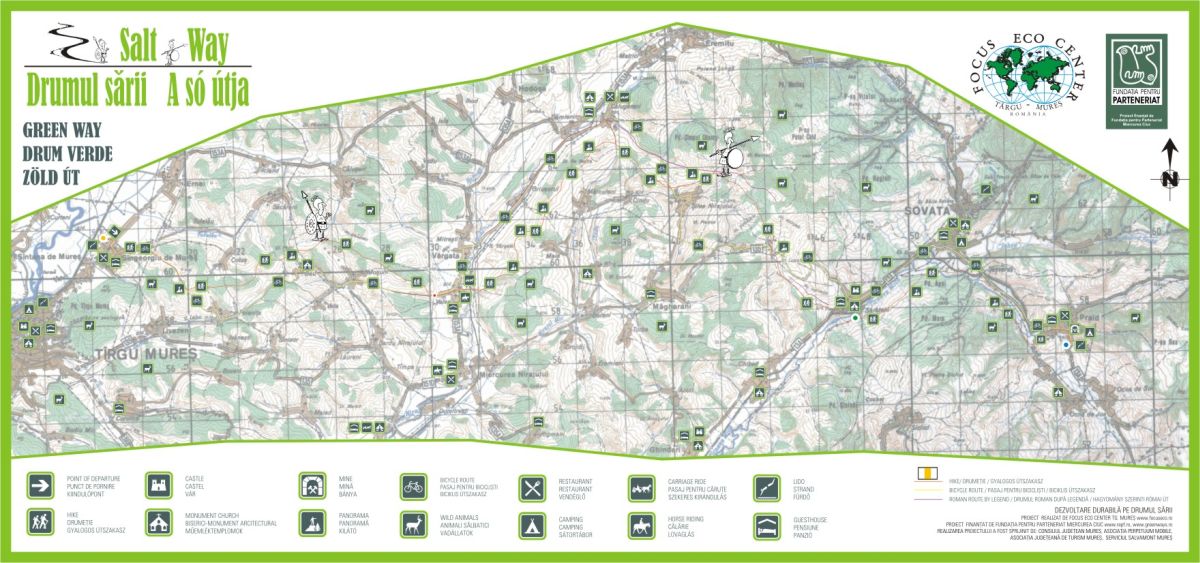
We launched the Salt Way programme to give people the opportunity to set out on foot from Târgu Mureș and enjoy walking, hiking and relaxation in nature. The marked walking trail starts in Marosszentgyörgy (Sângeorgiu de Mureș) and, following the course of a Roman road said to have passed here, reaches Parajd (Praid) after more than 50 km. It thus connects the salt baths of Marosszentgyörgy with the Praid Salt Mine. The route mainly crosses beautiful forests and meadows with fine views, passing through attractive, secluded villages such as Székelybő (Boiu) and Nyárádselye (Șilea Nirajului).
Nature lovers can observe rare plants and birds and often encounter roe deer and foxes. Mushroom enthusiasts can find many species, including field mushrooms (Agaricus campestris), parasol mushrooms (Macrolepiota procera), shaggy parasols (Macrolepiota rachodes) and charcoal burners (Russula cyanoxantha) in summer, and wood blewits (Lepista nuda) and clouded agarics (Clitocybe nebularis) in autumn. On reaching the Niraj Valley, walkers can stay and spend another pleasant day at the Tündér Ilona Guesthouse in Jobbágyfalva (Valea) or the Reneszánsz Guesthouse in Mikháza (Călugăreni). The marked trail then crosses Bekecs, where traces of the old Roman road are said to survive in the ‘Giants’ Ditch’. Continuing onwards, the route reaches the Târnava Mică Valley at Sóvárad (Sărățeni), where visitors can also find excellent accommodation and interesting activities. It then leads to Parajd, ending in the Salt Gorge. Alongside the scenic walking route, cyclists can also follow the Salt Way, staying closer to the actual course of the former Roman road. Salt, an important underground resource of the region, occurs along the Reghin–Sovata–Praid–Homorod fault line. About 25 million years ago, at the beginning of the Miocene, mountain-building movements intensified and, accompanied by massive volcanic activity, raised the Carpathian mountain arc. During the Lower Miocene, the Transylvanian Basin slowly subsided and rose, repeatedly flooding with seawater and drying out. These movements, together with the hot climate, created enormous salt deposits around the margins and especially at the bottom of the basin. These deposits have been mined from Roman times to the present day.
We hope that the Salt Way programme will provide a framework for local initiative, contribute to sustainable development of settlements along the route, and give visitors lasting memories.
Project archive