 Focus Eco Center
Project resource
Attractions along the Salt Way and in the surrounding area
Marosszentgyörgy (Sângeorgiu de Mureș)
In Marosszentgyörgy, famous for its therapeutic salt water and mud, a small bathing pool fed by a natural surface spring already existed in 1880. The landowner, Baron Béla Csete, noticed that pits dug on his property quickly filled with salt water. On 6 February 1902, he announced in Székely Lapok his intention to establish a joint-stock company to develop and operate the baths. By then, he had invested 12,000 crowns, but expenditure exceeded income. We also learn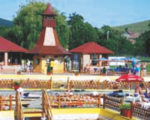 from Székely Lapok that the baths were officially opened on the fine weekend of 14–15 June 1902. Later, while searching for gas—Transylvanian gas contains 99.99% methane and is considered the purest in the world—drilling reached a depth of 864 metres on 2 May 1912, but salt water emerged instead of gas. Two further wells were later drilled to depths of 799 and 951 metres.
Székelybő (Boiu)
This secluded little village is an ancient Hungarian settlement. Its first written record appears in the papal tithe register of 1332, when its priest, Pál, paid ten denarii. With one exception, Székelykál in 1332, the first written references to neighbouring settlements are all later. Székelybő already had a parish church in 1332.
The entirely Catholic medieval population became Reformed during the Reformation, together with the church. In the mid-1700s, missionary work by Jesuits from Târgu Mureș led some inhabitants to return to the Catholic faith of their ancestors. In 1767, the Jesuits remodelled the church in the Baroque style of the period. It still stands in its original location, retaining none of its original style. The Reformed congregation built a prayer house in 1784. In 1828, they added a small tower using materials from the belfry that had stood on the site of the Small Church in Târgu Mureș.
Niraj Valley
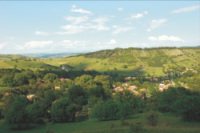
The region known as the Niraj Valley belongs to historical Marosszék and lies within the Niraj River catchment. According to Balázs Orbán, the Niraj is the most Szekler of rivers, as it flows past Szekler villages throughout its course. It rises at an altitude of 1,200 metres on the slopes of Mezőhavas in the Gurghiu Mountains, flows westwards and joins the Mureș at Nyárádtő (Ungheni), at 300 metres, after a journey of 79 km. Its catchment covers 625 square kilometres and contains 63 settlements, traditionally making it one of Transylvania’s most densely populated areas. The climate is continental, with an average temperature of 8.5°C and annual rainfall of 700–1,200 mm, although there are marked differences between the mountainous upper valley and the lower reaches at 300 metres. Most villagers are Szeklers, predominantly Reformed, Catholic or Unitarian. The landscape is dominated by Bekecs, the ‘sacred’ mountain of the Niraj Valley. The Great and Little Niraj flow around it on either side and meet at Nyárádszereda (Miercurea Nirajului), the area’s only small town. The Upper Niraj Valley, known as the ‘Holy Land’ because of its devout Catholic inhabitants, has extensive forests and trout streams. The Bekecs foothills are renowned for fruit growing. The local poet Mihály Szentiváni celebrated one of its most famous apple varieties in his poem Song of the Niraj Valley:
Below Bekecs lies the Niraj plain,
There stands a cottage roofed with thatch;
Yet inside it is a mine of gold,
Its gold a beautiful young girl.
Red Paris apple of Marosszék!
My sweetheart lives there too.
Fair is the apple on the branch,
My beloved a hundred times fairer still.
You are a cotter, I a Szekler,
Yet one sun rises in our sky;
One rain falls upon our land:
Why should I be worth more than you?
Along the middle reaches of the Niraj, orchards surround the villages, vineyards cover the hills and forests crown the higher ground. The Lower Niraj Valley is called ‘Carrot Country’, because vegetables such as carrots, parsley and celery thrive in the fertile soils of the floodplain.
Folk traditions that developed over centuries of coexistence between people and nature in the Niraj Valley, such as the Easter boundary walk, survive to this day. Visitors interested in these traditions can enjoy memorable experiences here.
Project archive